Auckland's housing rulebook is getting another look — and the decisions made in the coming months could shape where tens of thousands of new homes get built across the city for decades to come.
Auckland Council's Policy, Planning and Development Committee has endorsed two scenarios for potential changes to Plan Change 120 (PC120), kicking off a fresh round of consultation with local boards and iwi authorities. Here's what's going on, and why it matters.
A bit of background
PC120 is Auckland Council's big update to the Auckland Unitary Plan — the document that governs what can be built where across the region. The original plan, adopted in 2016, is estimated to allow capacity for around 1.2 million homes. PC120 was designed to push that number significantly higher.
But recent Government legislation has changed the goalposts. Auckland's minimum housing capacity requirement has been reduced from around 2 million homes to 1.4 million — giving the council more flexibility in how and where it enables growth.
Two scenarios on the table
Rather than jumping straight to a decision, the committee has put forward two scenarios for local boards and iwi authorities to weigh in on.
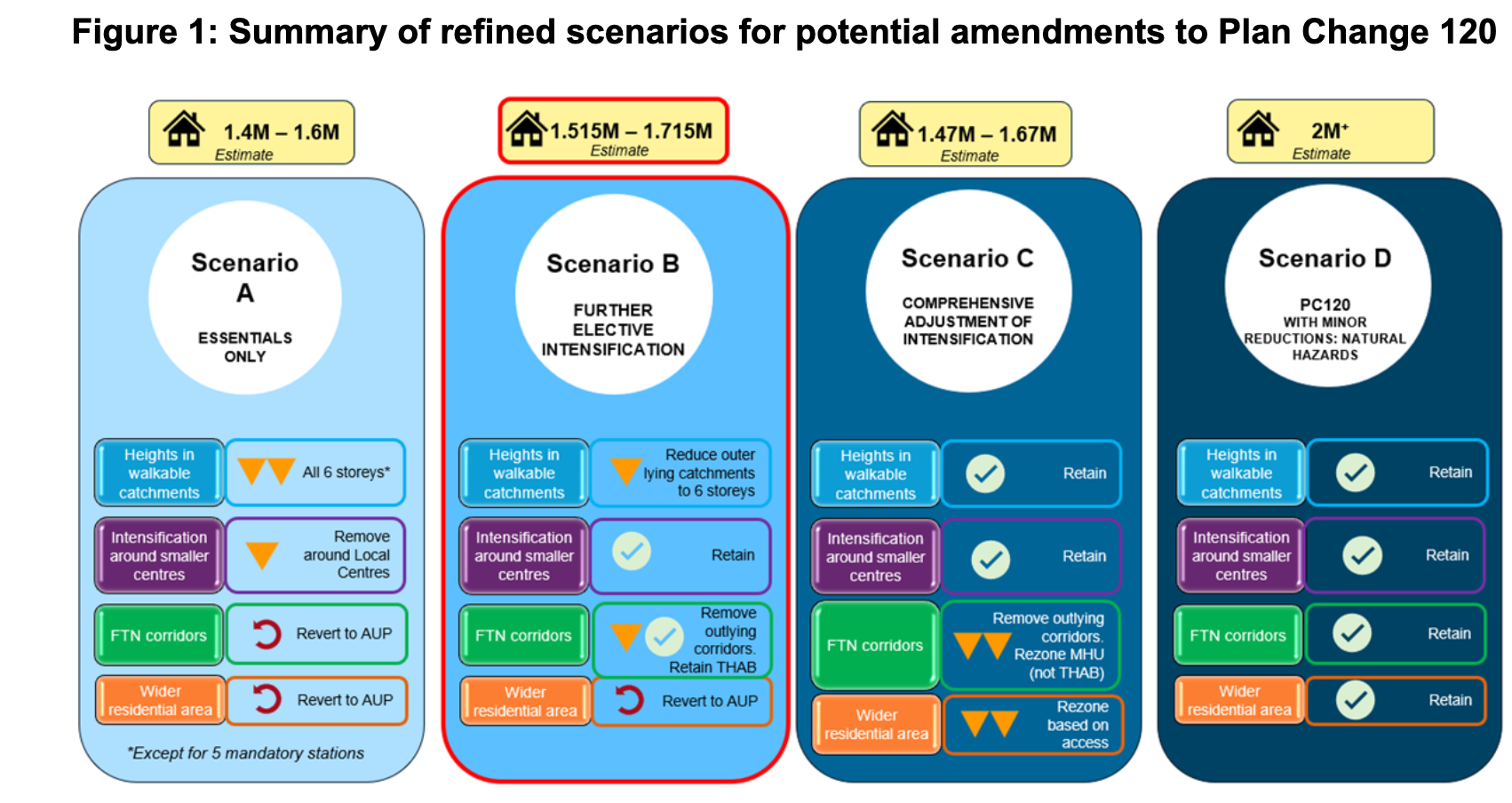
Scenario A meets the Government's mandatory requirements by focusing intensification around the city centre, metropolitan centres, rapid transit stops, and five Western Line train stations. Most of the additional housing that PC120 proposed outside those areas would largely revert back to the current Unitary Plan settings.
Scenario B goes a step further. It keeps the Government's mandatory requirements but also enables more housing around local centres and along frequent bus routes — areas with strong access to jobs, services, and public transport infrastructure.
Both scenarios maintain stronger flood protection rules, including downzoning in the most vulnerable areas based on updated flood modelling.
In terms of housing capacity, Scenario A would allow for between 1.4 and 1.6 million homes, while Scenario B would unlock between 1.5 and 1.7 million.
What does this actually mean for Auckland?
It's worth being clear about what "housing capacity" means — and what it doesn't. These figures aren't building targets. They represent the theoretical maximum if every property in Auckland were developed to the fullest extent the rules allow. In reality, how many homes actually get built depends on population growth, market demand, infrastructure, and the choices of individual property owners and developers.
Still, the zoning rules matter enormously. They determine where developers can legally build, and signal to the market where investment is welcome.
Mayor Wayne Brown has been vocal about his preference for intensification to follow transport investment — particularly around stations that benefit from the City Rail Link. He's also pushed back against what he sees as outside political influence on Auckland's planning decisions, arguing the city should set its own course.
What happens next?
Local boards and iwi authorities will now provide feedback on both scenarios. The committee is expected to review that input in July 2026, at which point it may decide whether to formally propose changes to PC120.
After that, Aucklanders will get another chance to have their say through a new round of public submissions. The more than 10,500 submissions already made on PC120 remain valid and won't need to be resubmitted.
An Independent Hearings Panel will then hold public hearings and make recommendations before the council makes final decisions — expected in mid-2027.